Best Promotional Products for Charities & Non-Profit Organisations
From pin badges and wristbands to volunteer t-shirts and thank-you pens, here's how UK charities and non-profits can use branded merchandise to fundraise, recruit volunteers and build donor loyalty on a tight budget.
The UK is home to more than 168,000 registered charities, and between them they rely on an enormous amount of goodwill, volunteer time, and tight budgets to do their work. Every pound spent on branded merchandise has to justify itself twice over: once as a marketing cost, and once against the question "could that money have gone straight to the cause instead?"
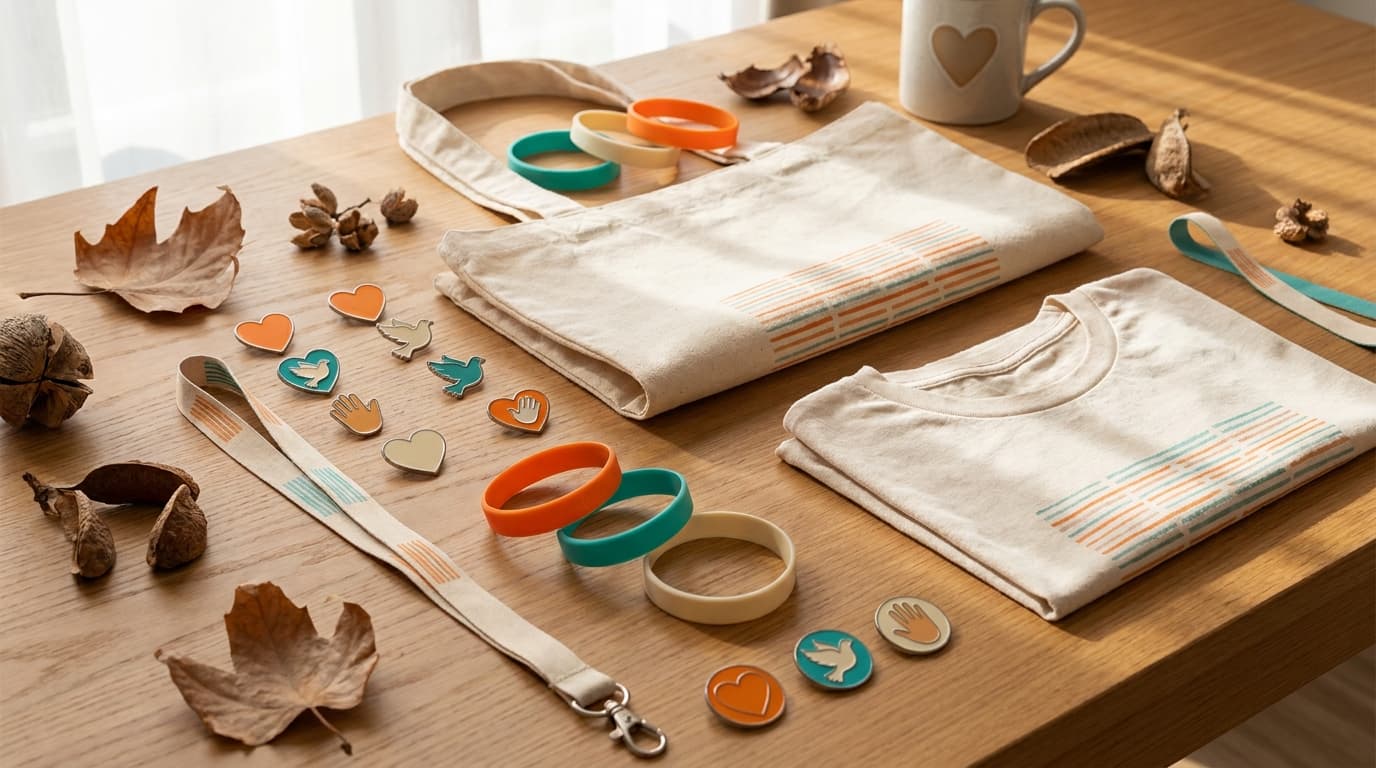
That's exactly why promotional products matter so much for charities and non-profits — when chosen well, they don't compete with the mission, they amplify it. A volunteer in a branded t-shirt at a bucket collection, a tote bag handed out at a fun run, a pin badge sold for £1 at a fundraising stall — these aren't just giveaways, they're low-cost fundraising tools, volunteer identifiers, and walking adverts for a cause, all at the same time.
This guide covers the best promotional products for charities, community groups, and non-profit organisations in the UK — what to buy for fundraising events, volunteer recognition, awareness campaigns, and corporate partnership gifting — along with budgeting advice for stretching every penny of a charity marketing spend.
Why Promotional Products Work Differently for Charities
Dual-Purpose Spending
For most businesses, a branded pen or tote bag is pure marketing cost. For a charity, the same item can be:
- Sold as a fundraising product (pin badges, wristbands, tote bags)
- Given to donors as a thank-you that encourages repeat giving
- Worn by volunteers and staff as instant on-the-ground identification
- Carried by supporters as free, ongoing brand awareness
This is why charity promotional spend tends to concentrate on a small number of versatile, low-unit-cost items rather than a wide, expensive product range — every item has to work hard across multiple jobs at once.
Trust and Transparency Matter More
Donors and the public are rightly sensitive to how much a charity spends on "admin" and marketing versus frontline work. The Charity Commission and watchdogs like the Fundraising Regulator expect spending to be proportionate and well justified. That makes low-cost, high-utility items — things that are genuinely useful or genuinely sellable — a much easier sell to trustees and the public than premium, flashy merchandise.
Volunteers Are the Front Line
Unlike a typical business, a charity's "brand ambassadors" on any given day are often unpaid volunteers — bucket collectors, event marshals, shop staff, fun run stewards. Branded clothing and accessories aren't just marketing; they're safety and legitimacy. A clearly branded volunteer is instantly recognisable to the public, easier for event organisers to spot in a crowd, and more likely to be trusted by someone being asked for a donation.
Best Promotional Products for Charities & Non-Profits
1. Pin Badges — The Classic Fundraising Tool
Pin badges remain one of the most effective charity fundraising products in the UK, and for good reason: they're cheap to produce, instantly recognisable, and people are genuinely willing to pay for one in exchange for a donation.
- Cost: from around £1.34 per unit at volume for printed pin badges, rising to £3.47 for premium domed metal badges with a magnetic fitting
- Best for: street collections, awareness days, small-donation campaigns
- Why it works: a £1–£2 badge sale against a sub-£1.50 cost still generates a direct net contribution per unit, while every badge worn afterwards is free ongoing advertising
Browse options in our pin badges range.
2. Silicone & Fabric Wristbands — Awareness on a Budget
Wristbands became a fundraising staple after campaigns like Band Aid and various cancer charities popularised the format, and they're still one of the lowest-cost ways to put a message directly on a supporter.
- Cost: from as little as £0.06–£0.15 per unit in bulk for silicone wristbands
- Best for: awareness campaigns, fun runs, festivals, school fundraising days
- Why it works: the unit cost is low enough that even a £1 "suggested donation" wristband generates a healthy margin, and debossed/printed messages keep the cause visible for weeks after the event
See the full wristbands collection.
3. Tote Bags & Drawstring Bags — Charity Shop & Event Essentials
Tote and drawstring bags do double duty: they're useful enough that supporters actually keep and reuse them, and they're a practical carrier item for charity shops, donation collection points, and event giveaways.
- Cost: basic cotton tote bags from around £0.23 per unit; jute long-handled shopping bags from £0.80; small cotton drawstring bags from £0.38
- Best for: charity shop merchandise, donation bag schemes, event sign-up gifts, retail-style fundraising
- Why it works: every time someone carries the bag to the shops, it's a free impression — and reusable bags align naturally with the sustainability values many charities already promote
Explore the tote bags and drawstring bags ranges.
4. Branded T-Shirts — Volunteer Identification & Fun Runs
If a charity buys only one item of clothing all year, it's usually a t-shirt — for marshals at a fun run, volunteers at a collection, or participants in a sponsored event.
- Cost: entry-level t-shirts from around £1.50 per unit, rising to £3.28–£3.73 for heavier sports and premium cotton styles
- Best for: fun runs, bake sales, bucket collections, "Team [Charity Name]" sponsored events
- Why it works: a sea of matching t-shirts at a sponsored walk or run is one of the most effective visual signals a charity can create — both for safeguarding (easy to spot who's official) and for the inevitable event photos that get shared on social media
View options in the t-shirts range.
5. Pens — Low-Cost Donor Thank-Yous
Pens are unglamorous but remain one of the cheapest ways to say thank you to a donor who's just filled in a Gift Aid form or signed up for a regular donation.
- Cost: from as little as £0.09–£0.12 per unit for basic and recycled ballpens
- Best for: direct debit sign-up gifts, office supplies for charity shops and branches, event registration desks
- Why it works: at under 10p a unit, a branded pen is one of the only promotional items a charity can give away to literally every single supporter without the spend ever becoming a governance issue
Browse the pens and writing range.
6. Lanyards — Event & Volunteer Management
For any charity running conferences, fundraising galas, or multi-day events, lanyards are a practical necessity as much as a branding opportunity — holding ID badges, access passes, and staff/volunteer differentiation in one place.
Browse the lanyards range, including eco lanyard options for charities keen to match their sustainability messaging.
Matching Products to Your Charity's Calendar
Awareness Days & Months
Wristbands and pin badges are purpose-built for single-day or single-month awareness campaigns — order a batch tied to your charity's key date (Children in Need, a cancer awareness month, a disability awareness week) and sell or distribute them in the run-up.
Sponsored Events & Fun Runs
T-shirts for participants and marshals, tote bags as a sign-up or finisher gift, and wristbands for quick visual identification of who's taking part all work well together as a coordinated event kit.
Giving Tuesday & Christmas Appeals
As the UK heads into the winter fundraising season — Giving Tuesday, Christmas Jumper Day, carol services, and year-end appeals — small branded thank-you items (pens, badges) alongside donation requests are a proven way to boost response rates on direct mail and email appeals.
Volunteer Recruitment & Retention
A branded t-shirt, lanyard, or tote bag given to a new volunteer on day one costs very little but sends a clear "you're part of the team" signal that improves retention — something every charity, which relies disproportionately on unpaid labour, has a direct interest in.
Corporate Partnerships & CSR Gifting
A growing share of UK charity income comes through corporate partnerships — payroll giving schemes, Charity of the Year arrangements, and one-off CSR (Corporate Social Responsibility) sponsorships. Promotional products play a quiet but important role in these relationships too.
Say Thank You to Corporate Supporters
A branded item sent to a company that's just completed a fundraising challenge, hit a payroll giving milestone, or sponsored an event is a simple way to close the loop and encourage renewal next year. A co-branded item — your charity's logo alongside the sponsor's — can also give the corporate partner something tangible to share internally with their own staff, which helps justify the partnership to their management.
Equip Staff for Joint Volunteering Days
Many corporate partnerships now include staff volunteering days — a warehouse sort, a park clean-up, a bake sale in the office. Branded t-shirts or tote bags for the volunteering company's staff make the day feel more like a shared event and less like a one-off favour, and the resulting photos are useful for both organisations' social media and annual reports.
Make It Easy for Companies to Say Yes
If you're pitching a new corporate partnership, having a ready-made, costed merchandise option ("we provide branded wristbands for your staff fun run team" or "we'll supply pin badges for your office collection point") removes friction from the conversation and makes the ask feel concrete rather than abstract.
Budgeting for Charity Promotional Products
- Start with items that can be sold, not just given away. Pin badges and wristbands with a suggested £1–£2 donation can turn a marketing line item into a small net fundraiser.
- Buy in bulk across the year, not per event. Ordering 5,000 pens or badges once a year is cheaper per unit than five separate orders of 1,000 — plan ahead for your known annual events.
- Reserve higher-cost items (t-shirts, premium bags) for high-visibility moments like fun runs and galas, where the per-impression value is highest.
- Ask about charity and bulk discounts. Many suppliers, including PMP, can work with registered charities on pricing for recurring annual orders.
- Keep branding simple. A clear logo and one-colour print keeps setup costs down and speeds up turnaround — important when fundraising events often get confirmed with short notice.
Frequently Asked Questions
Do charities get discounted pricing on promotional products?
Many suppliers, including PMP, are happy to discuss charity-friendly pricing for registered charities, particularly on recurring or bulk annual orders. Get in touch with your charity number to hand and we'll see what we can do.
What's the cheapest promotional product for a charity bucket collection?
Silicone wristbands and basic pin badges are the cheapest effective options, often costing under 20p per unit at volume, making them easy to offer in exchange for even a small donation.
How many branded t-shirts do we need for a fun run or sponsored walk?
As a rule of thumb, order enough for every official marshal and volunteer plus a buffer of 10–15% for last-minute sign-ups and replacements. Participant-facing events should separate "staff/marshal" colours from "participant" colours so the public can instantly tell who to approach.
Can we sell branded merchandise to raise funds, or is it only for giving away?
Both are common. Low-cost items like pin badges, wristbands, and tote bags are frequently sold directly to supporters at a markup as a fundraising mechanism, while higher-cost items like t-shirts and lanyards are more typically given to staff, volunteers, and major donors.
What lead time should we plan for a fundraising event?
Standard turnaround on most branded items is 1–2 weeks once artwork is approved, but popular items can sell out or need re-ordering around major awareness dates, so ordering 4–6 weeks ahead of a known event date is the safest approach.
Are eco-friendly promotional products more expensive for charities on a tight budget?
Not necessarily — many eco options like RPET tote bags, organic cotton drawstring bags, and recycled plastic pens are now priced close to standard equivalents, and the sustainability message often aligns well with a charity's existing values.
Do you offer small minimum order quantities for small charities and community groups?
Yes — many of our products, including pens, badges, and wristbands, are available from small minimum order quantities, which suits smaller charities and community groups that don't need thousands of units.
Why Choose PMP?
- 17+ years supplying UK businesses and organisations with branded merchandise
- Low minimum order quantities available across most ranges — ideal for smaller charities and community groups
- Charity-friendly pricing conversations for registered charities on recurring orders
- Fast turnaround to meet fundraising events and awareness days booked at short notice
- Free UK delivery on most orders, keeping more of your budget for the cause
- Expert advice on choosing products that work as both fundraising tools and brand awareness
Get Your Charity's Next Campaign Moving
Whether you're planning a bucket collection, a sponsored fun run, a Christmas appeal, or simply want branded merchandise for your volunteers, we can help you find products that stretch your budget as far as possible. Request a quote today and let us know you're a registered charity — we'll talk through the best options for your event and your donors.
Related Articles

Need promotional products?
Get a free quote from our team. We'll help you find the perfect products for your brand.
Get a Free Quote